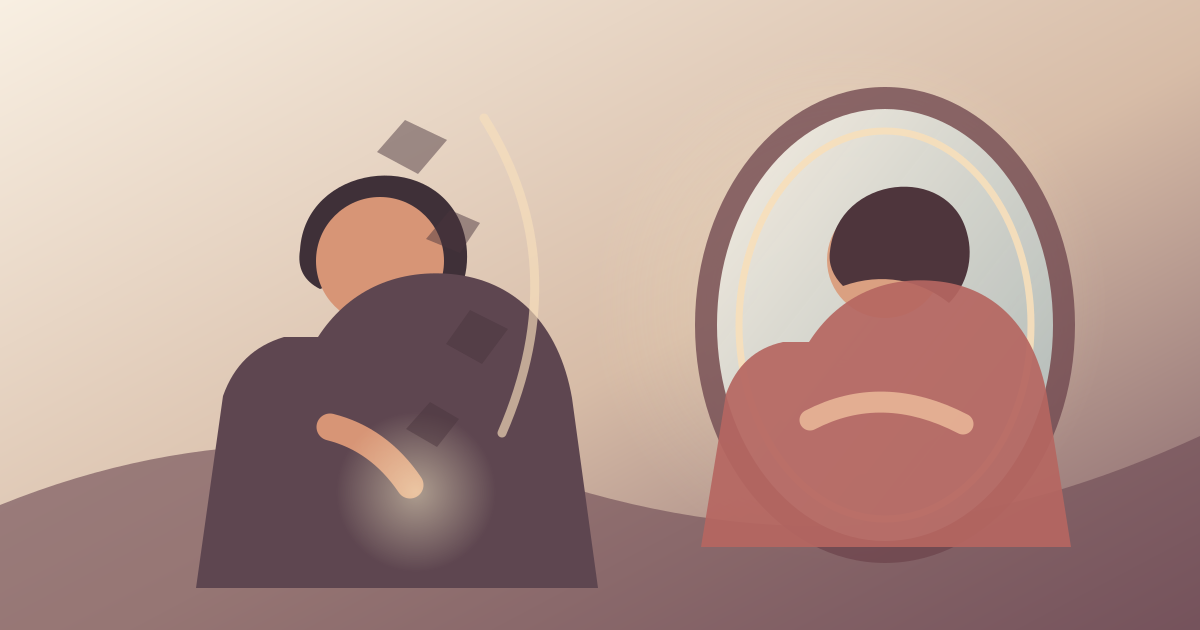
Sometimes one part of you understands that a present situation is manageable, while another part feels panic, shame, loneliness, or an urgent need to earn approval. This does not mean you are pretending to be younger or that a separate child lives inside you. It can mean that the present has activated emotional learning from a time when you had fewer choices, less power, and less support.
What the phrase “inner child” means
The inner child is a popular metaphor, not a diagnosis. It offers a simple way to talk about early feelings, needs, beliefs, expectations, and protective strategies that can remain active in adulthood. Children learn about themselves through relationships: whether asking for help is safe, whether mistakes are tolerated, whether emotions are welcomed, and whether personal limits are respected.
When care was inconsistent, frightening, or emotionally unavailable, a child may adapt by becoming unusually quiet, useful, independent, watchful, entertaining, or responsible for other people's moods. Those strategies may have reduced conflict or protected connection at the time. Years later, they can continue automatically even when the environment has changed.
How early emotional learning may show up now
The clearest clues are often reactions that feel larger than the current event. This does not mean the present concern is imaginary. It means the current facts and an older expectation may be operating at the same time.
- You fear that a close relationship will end after ordinary disagreement.
- A small correction quickly becomes the belief that something is fundamentally wrong with you.
- Saying no feels dangerous even when a request is exhausting, unfair, or intrusive.
- You try to earn love through usefulness, achievement, emotional caretaking, or constant availability.
- After a mistake, you want to hide, overexplain, apologize repeatedly, or punish yourself.
- Needing support feels shameful, so you manage everything alone until you are depleted.
Why a reaction can feel larger than the event
The present can resemble the past through tone, distance, uncertainty, or a body sensation rather than through exact details. A partner's short reply may awaken an old fear of abandonment. Feedback from a supervisor may feel like proof of worthlessness. Your nervous system can move quickly into protection before your reflective, adult perspective has time to catch up.
A helpful response holds two truths together: the feeling may have an understandable history, and the present deserves a fresh assessment. You do not have to argue that the feeling is irrational. You can listen to it while checking what is actually happening now.
What keeps an old pattern active
Automatic reactions often become stronger when the only responses are avoidance, self-criticism, or urgent reassurance. These strategies can reduce distress for a moment, but the relief may teach the brain that the feeling was dangerous and that you could not tolerate it without escaping or being rescued.
- regularly suppressing anger, sadness, fear, or need;
- calling yourself weak, lazy, dramatic, or too sensitive;
- avoiding conversations that require you to name a need or limit;
- automatically pleasing people to protect the relationship;
- expecting others to guess what hurts instead of speaking directly;
- repeating relationships in which familiar pain feels normal.
A seven-minute practice: Then and now
Use this practice only when you feel reasonably stable. Its purpose is not to recover every memory or prove exactly where a reaction came from. The purpose is to notice a present response and add the information, resources, and care available to you as an adult.
Return to the present
Write brief answers or say them silently. Keep your eyes open if that helps you stay oriented.
- Describe the current event using only observable facts.
- Notice your body: tension, heat, shaking, heaviness, numbness, or an urge to leave.
- Name one or two emotions without judging them.
- Ask: “How old do I feel right now?” Treat the first answer as a clue, not a fact you must prove.
- Complete: “Back then, I most needed…” Examples include protection, explanation, permission to say no, comfort, or reliable attention.
- Remind yourself of your current age, location, choices, supportive people, and practical resources.
- Choose one small adult action: pause, ask for time, set a limit, contact support, eat, rest, or delay a decision until you are calmer.
What supportive adult care can look like
- using precise language instead of global self-judgments;
- making your environment more predictable where possible;
- allowing a need without assuming another person must meet it exactly as imagined;
- choosing relationships in which repair, boundaries, and honest disagreement are possible;
- seeking trauma-informed professional care when symptoms are persistent or disabling;
- building self-support through repeated small actions rather than one dramatic breakthrough.
Key takeaways
- The inner child is a metaphor for early emotional learning, not a medical diagnosis.
- Old protective strategies can remain active after the environment changes.
- Acknowledging a feeling and checking present-day facts can happen at the same time.
- Safe reflection adds adult resources; it does not require forced memory recovery.