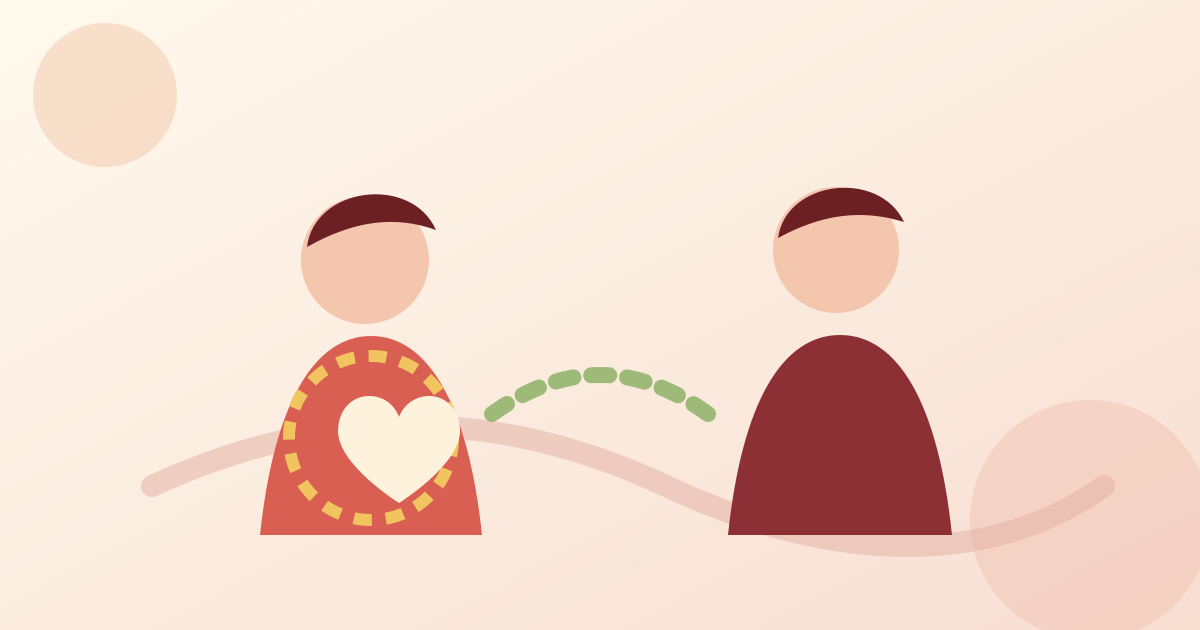
If disagreement in childhood led to punishment, ridicule, silence, or loss of affection, boundaries may feel dangerous in adulthood. Your body may expect honesty to cause rejection. You may know intellectually that you can say no, while guilt and fear insist that you must keep everyone comfortable.
What a boundary is—and what it is not
A boundary describes what is acceptable to you and what you will do if the situation continues. It is not a command that guarantees another person's behavior. “You must never raise your voice” is an attempt to control. “If shouting begins, I will pause the conversation and return when we can speak safely” describes your action.
Boundaries also differ from punishment. A proportionate boundary protects safety, time, privacy, money, energy, or dignity. Punishment is designed primarily to cause pain or force compliance.
Why a simple no can feel dangerous
- You learned that good children never disappointed adults.
- Care or affection was withdrawn after disagreement.
- You were responsible for a parent's mood or family peace.
- Requests were presented as obligations, not choices.
- Privacy was mocked or treated as disloyalty.
- Conflict included threats, violence, or unpredictable retaliation.
Identify the actual limit
Before speaking, clarify what is happening. Is the problem the request itself, the amount, the timing, the tone, the repeated pattern, or the consequence? A clear limit is easier to communicate than a global accusation.
A four-part boundary practice
Behavior, impact, limit, action
Begin with a lower-risk situation rather than the most dangerous relationship in your life.
- Name the specific behavior without diagnosing the person.
- Describe the impact on your time, body, work, privacy, or relationship.
- State the limit in one sentence.
- Name the action you will take if the behavior continues.
- Remove long explanations that invite debate about whether your need is legitimate.
- Practice the sentence aloud at a calm volume.
- Choose a time and place that support safety.
- After speaking, allow guilt to rise and fall without immediately canceling the boundary.
Examples of clear language
- “I am not available for calls after 9 p.m. I will respond the next day.”
- “I can help for one hour, but I cannot take over the whole task.”
- “I will not discuss my medical information in front of other people.”
- “If insults begin, I will end the conversation.”
- “I understand that you disagree. My decision remains the same.”
- “I need time before answering; I will respond tomorrow.”
When boundaries reveal the quality of a relationship
Healthy relationships do not require perfect agreement. They allow questions, negotiation, disappointment, repair, and the right to leave a conversation without retaliation. A person may dislike your limit and still respect it.
Repeated threats, stalking, financial control, humiliation, physical violence, or punishment for disagreement are not communication problems alone. In those situations, direct confrontation may increase danger. Safety planning and outside support matter more than delivering the perfect boundary statement.
How to tolerate the guilt afterward
Guilt after a boundary can be a conditioned alarm rather than evidence of wrongdoing. Check the facts: Was the limit related to your rights and resources? Was the language proportionate? Did you leave room for the other person's choices? If so, discomfort may be part of learning rather than a signal to reverse the decision.
Key takeaways
- A boundary describes your limit and your action; it does not control another person.
- Discomfort or disagreement does not automatically make a boundary unfair.
- Clear language is specific, proportionate, and focused on behavior.
- Safety planning takes priority when there is abuse or retaliation.